For the following aerodromes the orders regarding the good order and safety are approved by the Ministry of Infrastructure and Water Management.
The orders in question are available at the office of the airport authority and are obtainable upon payment.
The international Standards, Recommended Practices and Procedures contained in the following ICAO documents are applicable:
Differences to these provisions are detailed in GEN 1.7.
The Minister of Defence has opened the following military aerodromes: BERGEN OP ZOOM/Woensdrecht, BREDA/Gilze-Rijen, DEN HELDER/De Kooy, EINDHOVEN/Eindhoven, LEEUWARDEN/Leeuwarden and UDEN/Volkel, which may be used by civil aircraft under certain conditions.
Use of these military aerodromes may only take place during normal operational hours.
At first radio contact with the air traffic control unit of a military aerodrome (Approach Control or Tower) the pilot in command shall report the number of persons on board of the aircraft. In case of omission the air traffic control unit will request this information.
Requests for civil use of the military aerodromes should be directed to the following addresses:
| Aerodrome | Address | Remarks | ||||||||||||||||
|
BERGEN OP ZOOM/Woensdrecht
BREDA/Gilze-Rijen DEN HELDER/De Kooy LEEUWARDEN/Leeuwarden UDEN/Volkel |
|
|||||||||||||||||
| EINDHOVEN/Eindhoven |
|
Requests shall contain the requested data as stated in paragraph 2.1.3 item a up to and including l, plus the MTOM, with due observance of the time schedule: MON-SUN H24 PPR. |
The Commanders of the Royal Netherlands Navy and the Royal Netherlands Air and Space Force have stated that for each separate flight a request should reach the relevant Staff at least one week (but preferably two weeks) before the date of the intended use and should include the following:
1)The landing fees will be charged to this agency or company afterwards, unless they have been collected by a local dispatch company.
- Date of use.
- Manufacture and type of aircraft.
- Nationality and registration marks.
- Departure aerodrome.
- ETA at and ETD from the military aerodrome concerned.
- Destination aerodrome.
- Total landing weight (in LB).
- Tyre-pressure of aircraft (in PSI).
- Radio frequency available (channel 122.100 is required).
- Reason of use of military aerodrome concerned.
- Total number of persons on board.
- Name of the Dutch agency or company 1) to be visited including postal address, email address and telephone number.
- The Dutch agency or company shall ask exemption of the Customs Decree at the relevant Office of Import and Excise duties. In case no prior arrangements have been made, flights into or from abroad shall be executed via a customs aerodrome in the Netherlands.
The applicant will be informed in time of the decision on the request in writing. With regard to the permission granted by the above mentioned authorities, the General and Particular Conditions, as laid down by the Minister of Defence, apply, copies of these Conditions are available at the flight information offices of the civil and military aerodromes and will be supplied on written request by the Air Staff in Breda.
Special attention is drawn to the fact that day markings of the runways, taxiways and obstacles at RNLASF airfields differ from ICAO Standards.
In the flight plans of flights to a military aerodrome the expected landing weight and tyre pressure, in PSI, shall be stated under item 18.
This does not apply for aircraft with an AUW of 6000 KG or less.
This permission does not entitle the licence holder to have covered housing space for aircraft be made available. Also no claim can be drawn to receive facilities in the form of the supply of aviation fuel, oil and lubricants or in the form of assistance, guard duties, etc. to be rendered by government personnel and/or material.
During the approach to a military aerodrome it is forbidden to continue the descent beyond the point at which it appears to the captain of the aircraft that the approach minima (minimum descent altitude, decision height and weather minima), established for the aerodrome concerned and listed in paragraph 2.2, are not met.
Due to the limited operational hours of the military aerodromes, through flight plans shall, in order to avoid delays, be filed at least 24 hours before the expected time of landing. If a through flight is required on Monday, the flight plan concerned has to be received on the preceding working day within the published operational hours (paragraph 2.1.1).
During wintry conditions or excessive rainfall, runway surface conditions at the military aerodromes are reported in accordance with the global reporting format (GRF). The military aerodromes use the runway condition assessment matrix (RCAM) to assess paved runway surfaces, report contaminants present, and determine the numerical runway condition codes (RWYCC) based on the RCAM. RWYCC values range from 0 (less than poor) to 6 (dry).
Note:
except for the necessary permission from the Military Authority concerned, also permission from the Directorate General for Civil Aviation and Maritime Affairs (for details see GEN 1.1) must be obtained in those cases when such is required.
Note:
outside the normal operational hours of the military aerodromes glider flying activities may take place. These glider activities are subject to permission from the military authorities.
For military aerodromes the competent authorities have established the following aircraft approach categories which will be referred to with the designations A, B, C, D or E.
Note:
speeds are based on 1.3 times the stall speed in the landing configuration at maximum gross landing weight.
The approach minima for the military aerodromes are based on ICAO document 8168 OPS/611 (PANS-OPS) and NATO Standard agreement 3759.
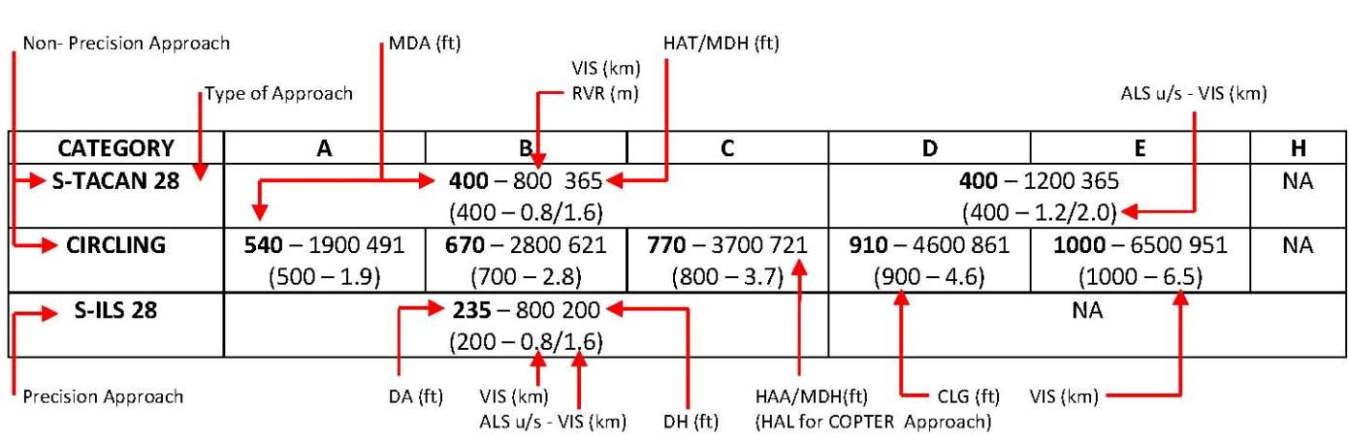
The following abbreviations and their meanings only apply to this paragraph.
AD ELEV 63 FT.
AD ELEV 49 FT.
See EHKD AD 2.24.
See EHEH AD 2.24.
AD ELEV 4 FT
AD ELEV 73 FT.
See relevant aerodromes, section AD 2.22.
See relevant aerodromes, section AD 2.22.
Notes:
1) If the relevant runway is exclusively in use for ILS approaches, the visibility criterion of 5 KM may be reduced to a minimum of 3 KM.
2) At these weather criteria the approach and runway lighting may be switched on when deemed necessary by ATC or on request of the pilot (e.g. low altitude of the sun or in twilight).
3) The time for SR and SS is published in GEN 2.7.
4) A minimum light intensity of 0.3% for approach and runway lighting is available. This setting can be used on request of the pilot or initiated by TWR in good visibility conditions (normally CAVOK) at night.
5) On request these intensities can be changed.
|
Designation
Heliport reference point coordinates |
Site at hospital
|
Heliport operator
TEL NR |
Time of ACT
Remarks |
|---|---|---|---|
|
1
|
2
|
3
|
4
|
|
AMSTERDAM/Vu Medisch Centrum
522004N 0045133E |
On rooftop
|
VU Medisch Centrum
TEL: +31 (0)20 444 4330 |
H24, 20 MIN PPR.
Contact Schiphol TWR. |
|
BEVERWIJK/Rode Kruis Ziekenhuis
522845N 0043906E |
On rooftop, southeast of hospital
|
Rode Kruis Ziekenhuis Beverwijk
TEL: +31 (0)251 783 814 |
H24, 30 MIN PPR.
|
|
DEN HAAG/Haga Ziekenhuis, Locatie Leyweg
520321N 0041545E |
On lower hospital rooftop
|
Haga Ziekenhuis, meldkamer Toegang & Gebouwveiligheid
TEL: +31 (0)70 210 2621 |
H24, 20 MIN PPR.
|
|
DEN HAAG/Mc Haaglanden, Locatie Westeinde
520426N 0041801E |
On roof of hospital
|
Westeinde Ziekenhuis Den Haag
TEL: +31 (0)88 979 2610 |
H24.
Contact Amsterdam Information on 124.300, 30 MIN before landing. |
|
ENSCHEDE/Medisch Spectrum Twente
521256N 0065329E |
On roof SW building of the hospital
|
Medisch Spectrum Twente
TEL: +31 (0)6 3175 1339 if no reply +31 (0)6 3175 1117 |
H24, 15 MIN PPR.
URL: https://www.mst.nl/over-mst-overzicht/heliport |
|
GOES/Adrz
512905N 0035438E |
East of hospital
|
Gemeenschappelijke Meldkamer Zeeland (GMZ)
TEL: +31 (0)88 061 7330 Adrz, Locatie Goes (hospital) TEL: +31 (0)88 125 4797 |
H24, 30 MIN PPR.
Helicopter operators are advised to contact GMZ and the hospital well before landing. |
|
GRONINGEN/Universitair Medisch Centrum
531318N 0063434E |
On roof of hospital
|
Universitair Medisch Centrum Groningen
TEL: +31(0)50 361 2264 TEL: +31(0)50 361 4503 |
SR-SS, 20 MIN PPR. Trauma flights excepted: H24, 30 MIN PPR.
Contact Eelde TWR 30 MIN before landing via RTF or TEL: +31 (0)50 309 9220. Pilots may be advised to hold over point X-RAY or YANKEE (see AD 2 EHGG VAC - 1). |
|
LEEUWARDEN/Frisius Medisch Centrum Leeuwarden
531119N 0054810E |
SW of hospital on roof of parking facility
|
Frisius Medisch Centrum Leeuwarden
TEL: +31 (0)58 286 6512 |
H24, 20 MIN PPR.
URL: https://www.frisiusmc.nl/heliport |
|
LEIDEN/Leids Universitair Medisch Centrum
520959N 0042841E |
On roof of hospital
|
Leids Universitair Medisch Centrum
TEL: +31 (0)71 526 2888 |
H24.
Contact Amsterdam Information 30 MIN before landing. |
|
MAASTRICHT/Maastricht Universitair Medisch Centrum
505004N 0054245E |
SW of hospital
|
Maastricht Universitair Medisch Centrum
TEL: +31 (0)43 387 5566 TEL: +31 (0)43 387 6543 |
H24.
- Contact heliport operator 15 MIN before landing to arrange rescue and fire fighting services. - Contact Beek TWR or outside AD OPR HR Dutch MIL. |
|
NIJMEGEN/Umc St. Radboud
514924N 0055147E |
On hospital rooftop
|
UMC St. Radboud
TEL: +31 (0)24 361 9000 |
H24, 20 MIN PPR.
|
|
ROTTERDAM/Erasmus Medisch Centrum
515436N 0042815E |
On elevated platform, south of hospital
|
Erasmus Medisch Centrum
TEL: +31 (0)10 703 3974 TEL: +31 (0)10 703 3124 |
H24.
Contact Rotterdam TWR 30 MIN before landing. |
|
SNEEK/Antonius Ziekenhuis
530205N 0053824E |
W of hospital
|
Antonius Ziekenhuis
TEL: +31 (0)515 488 888 |
H24.
BTN 1530-0630 (1430-0530): contact operator AD 30 MIN before landing. |
|
TERNEUZEN/Ziekenhuis Zeeuws-vlaanderen, Locatie De Honte
511830N 0035145E |
S of hospital
|
Ziekenhuis Zeeuws-Vlaanderen, Locatie De Honte
TEL: +31 (0)115 688 000 |
H24, 30 MIN PPR.
|
|
TILBURG/St. Elisabeth Ziekenhuis
513220N 0050617E |
S of hospital
|
St. Elisabeth Ziekenhuis Tilburg
TEL: +31 (0)13 221 2220 |
H24.
During OPR HR contact Gilze-Rijen TWR 30 MIN before landing. Outside OPR HR contact Dutch MIL INFO. |
|
UTRECHT/Universitair Medisch Centrum Utrecht
520512N 0051053E* |
On hospital rooftop
|
Universitair Medisch Centrum Utrecht
TEL: +31 (0)88 75 666 22 |
0600-2200 (0500-2100). Trauma flights excepted: H24.
|
|
ZWOLLE/Isala Klinieken, Locatie Sophia
523049N 0060721E |
On hospital rooftop
|
Isala Klinieken, Locatie Sophia
TEL: +31 (0)38 424 5464 |
H24, 30 MIN PPR.
|
Reduced runway separation minima between aircraft using the same runway may be applied at controlled civil aerodromes in the Netherlands according to EU 2017/373 AMC9 ATS.TR.210(c)(2)(i) Operation of air traffic control service. See AD 2.20 of the appropriate aerodrome.
ATC shall use the procedures as described below:
- Reduced runway separation minima shall only be applied during the hours of daylight from 30 minutes after local sunrise to 30 minutes before local sunset.
-
For the purpose of reduced runway separation, aircraft shall be classified as follows:
- category 1 aircraft: single-engine propeller aircraft with a maximum certificated take-off mass (MCTOM) of 2000 KG or less;
- category 2 aircraft: single-engine propeller aircraft with a maximum certificated take-off mass of more than 2000 KG but less than 7000 KG, and twin-engine propeller aircraft with a maximum certificated take-off mass of less than 7000 KG; and
- category 3 aircraft: all other aircraft.
- Reduced runway separation minima shall not apply between a departing aircraft and a preceding landing aircraft.
-
Reduced runway separation minima shall be subject to the following conditions:
- wake turbulence separation minima shall be applied;
- visibility shall be at least 5 KM and ceiling shall not be lower than 300 M (1000 FT);
- tailwind component shall not exceed 5 KT;
- there shall be available means, such as suitable landmarks, to assist the air traffic controller in assessing the distances between aircraft. A surface movement ATS surveillance system that provides the air traffic controller with position information on aircraft may be utilised, provided that approval for operational use of such equipment includes a safety assessment to ensure that all requisite operational and performance requirements are met;
- minimum separation continues to exist between two departing aircraft immediately after take-off of the second aircraft;
- traffic information shall be provided to the flight crew of the succeeding aircraft concerned; and
- the braking action shall not be adversely affected by runway contaminants such as ice, slush, snow and water.
-
Reduced runway separation minima which may be applied at an aerodrome shall be determined for each runway. The separation to be applied shall in no case be less than the following minima:
-
landing aircraft:
- a succeeding landing category 1 aircraft may cross the runway threshold when the preceding aircraft is a category 1 or 2 aircraft, which either:
- a succeeding landing Category 2 aircraft may cross the runway threshold when the preceding aircraft is a category 1 or 2 aircraft, which either:
- a succeeding landing aircraft may cross the runway threshold when a preceding category 3 aircraft:
-
departing aircraft:
- a category 1 aircraft may be cleared for take-off when the preceding departing aircraft is a category 1 or 2 aircraft which is airborne and has passed a point at least 600 M from the position of the succeeding aircraft;
- a category 2 aircraft may be cleared for take-off when the preceding departing aircraft is a category 1 or 2 aircraft which is airborne and has passed a point at least 1500 M from the position of the succeeding aircraft; and
- an aircraft may be cleared for take-off when a preceding departing category 3 aircraft is airborne and has passed a point at least 2400 M from the position of the succeeding aircraft.
-
landing aircraft:
The RNLASF uses tailhook cable systems only.
| NOMENCLATURE | TYPE | ABSORBING CAPACITY | CABLE | ||
| Ekin.Design | Ekin. Emerg. | Runout | Diameter | ||
| BAK-12 ER Smart Arrest (UNIDIRECTIONAL) 1) | BAK 12 | 40X106 ft.PNDS | 1200 FT | 1-1/14 inch | |
The arresting capability is limited by the absorbing capacity of the system and the hookload of the aircraft.
The absorbing capacity is limited to the Ekin. Design for RNLASF and to Ekin. Emerg. for visiting aircraft. Formula to be used:
Ekin.Design = WV
2/22.5
W = aircraft weight
V = engaging velocity
The hookload of the aircraft is limited to the 'Design hookload' for RNLASF and to the 'Hookload-yield' for visiting aircraft (hookload-yield = 1.15 x hookload design).
Maximum energy absorber weight/speed; 40.000 lbs (18140 kg) at 140 KTS.
When the ACN is a little bit more than the PCN the plane will not immediate sink into the pavement. But when such an event happens more times, material tiredness occurs with cracking and settlement as result. To give technically based guidelines for overload operations for most of the MIL AD pavements an so called “Overload PCN” is assessed beside the normal PCN. ACNs more than the normal PCN but not more than the overload PCN can be allowed for a maximum of 40 times a year (use a “gliding year”).
Exceeding the overload PCN or the restriction of 40 times in a year will course structural damage to the pavement with severe reduction of its lifetime. However it might occur that a special mission is more important than the lifetime of the pavement. For this kind of operations a “waiver” is required. Waivers have to be requested at CLRS/DO with a copy to the base commander.